
What is open enrollment? It’s the annual period when eligible people can enroll in health insurance, renew their current coverage, or switch to a different plan. The dates and rules depend on the type of coverage.
For your practice, open enrollment means more insurance questions, new plan details, and extra work for your front desk and billing teams. A patient’s new coverage can change eligibility checks, network participation, authorization requirements, and expected out of pocket costs.
In Texas, the 2027 ACA Marketplace open enrollment period runs from November 1, 2026, to January 15, 2027. Medicare has its own schedule. This guide covers the dates, the patient coverage changes, and the steps your practice can take before January appointments.
Scope: This guide covers ACA Marketplace and Medicare enrollment for Texas practices. Employer plans follow each employer’s schedule.
Key Takeaways
- Marketplace open enrollment for 2027 coverage runs November 1, 2026, to January 15, 2027.
- Medicare Open Enrollment runs October 15 to December 7, so patient questions start now.
- Review the specific insurance products and networks your providers participate in.
- Check eligibility, benefits, and authorization requirements for the actual date of service.
- Remember that eligibility verification doesn’t guarantee claim payment.
- Send patients to HealthCare.gov and Medicare.gov and let them make their own coverage choices.
What Is Open Enrollment?
Open enrollment is a set window each year when people can sign up for a health plan, renew their coverage, or switch to a different plan. Once it closes, they usually can’t change plans unless a qualifying event applies. That’s why the open enrollment period for health insurance shapes your patient’s flow every year.
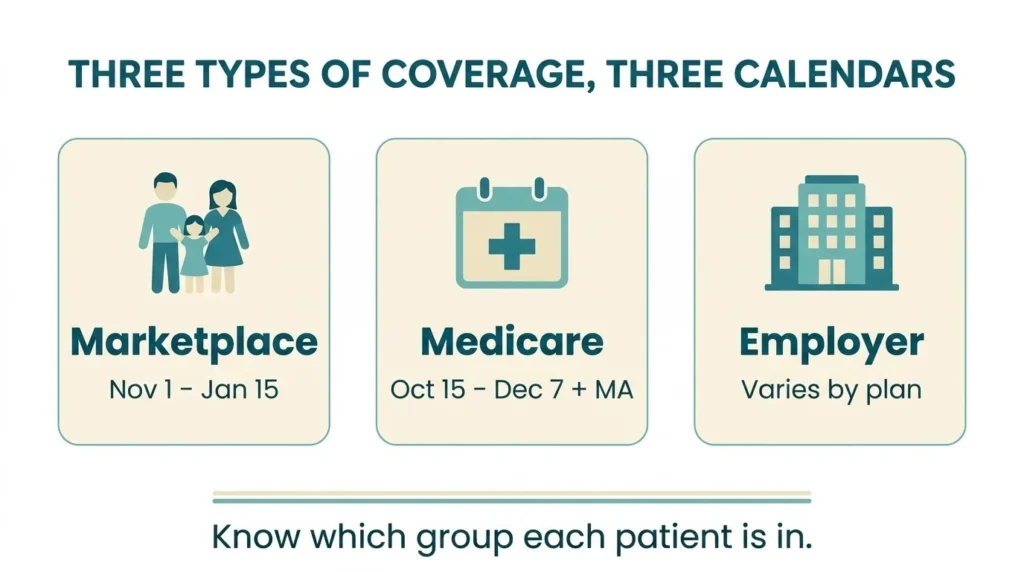
Three types of coverage follow three different calendars:
- Marketplace open enrollment covers individual and family plans.
- Medicare enrollment periods follow their own calendar, and Medicare Advantage has an extra window.
- Employer benefits enrollment follows each employer’s or plan’s schedule.
Know which group each patient falls into, so your team gives the right answer the first time. Open enrollment eligibility depends on where a patient lives and what coverage they already have.
Open Enrollment Dates and Deadlines for Health Insurance
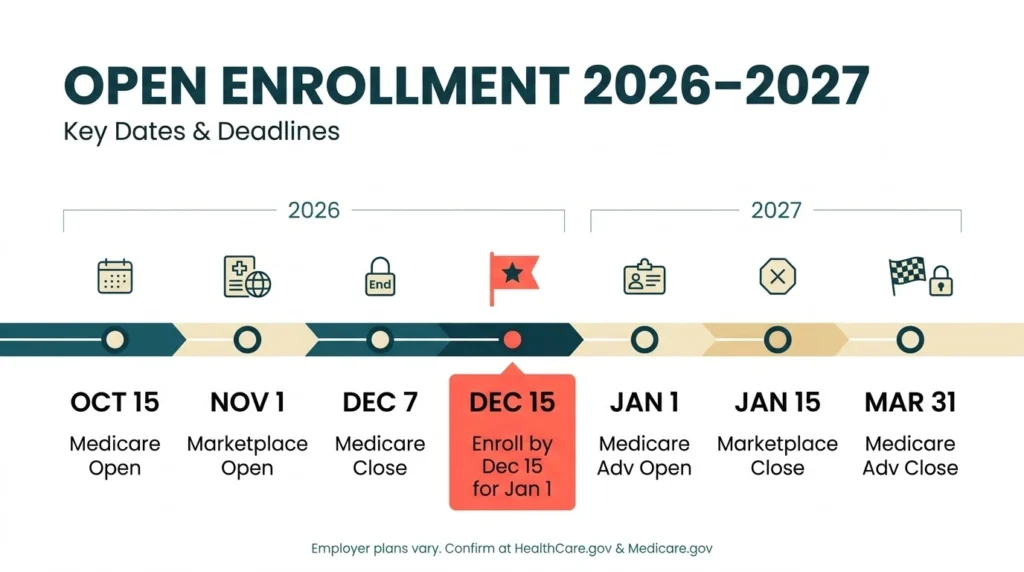
For the Texas health insurance Marketplace, the ACA open enrollment period follows the federal schedule. Here are the dates HealthCare.gov and Medicare.gov list, with what each one means for your practice:
| Coverage type | Period or deadline | What your practice should prepare for |
| ACA Marketplace, including Texas | November 1, 2026, to January 15, 2027 | Coverage changes, new plan details, eligibility checks, and network verification |
| Marketplace deadline for January 1 coverage | December 15, 2026 | Patients who enroll or change plans after this date generally start February 1 instead |
| Medicare Open Enrollment | October 15 to December 7, 2026 | Patients reviewing Medicare health and drug plan choices for 2027 |
| Medicare Advantage Open Enrollment | January 1 to March 31, 2027 | Changes by patients already in a Medicare Advantage plan |
| Employer sponsored benefits | Varies by employer or plan | Confirm each patient’s new benefits and start date, and don’t assume Marketplace deadlines apply |
Here’s why December 15 matters to you. A patient who enrolls on December 10 has coverage that starts January 1, if they pay the first premium. A patient who enrolls on January 5 has coverage that starts February 1, so that patient may arrive in January with no active plan. Verify coverage before every January visit.
Confirm these open enrollment dates on HealthCare.gov before you publish them on your site, because dates can change from year to year. The open enrollment health insurance deadline also differs by coverage type, so tell patients to check their own plan.
How Does Open Enrollment Work?
So how does open enrollment work? Patients check their open enrollment eligibility and dates, review their current coverage, compare plans and costs, and submit an application before the deadline. Then they pay the first premium, because coverage won’t start until they do. Your team should explain this process of enrollment in plain words.
The open enrollment period for health insurance also lets patients update a plan they already have. Send patients to HealthCare.gov for help, and don’t recommend a specific plan unless your staff holds the license to give that advice.
How Open Enrollment Affects Healthcare Practices
Open enrollment doesn’t change every patient’s insurance automatically. However, some patients switch plans, choose new benefits, or start coverage on a different date. These changes affect your front desk, your billing team, and your revenue cycle. Your goal isn’t to advise patients which plan to choose. It’s to build a reliable process for checking coverage and explaining expected costs before providing care.
Insurance Eligibility Verification and Benefits Checks
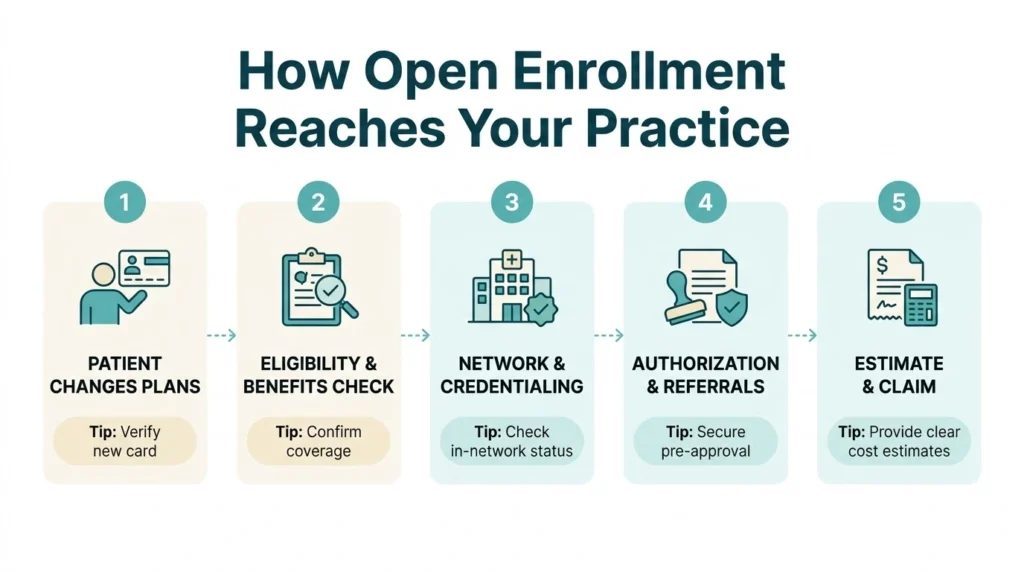
A patient may keep the same insurance company but choose a different plan. The name on the insurance card doesn’t confirm that the plan is active or that your practice participates in its network. Before the appointment, confirm coverage for the actual date of service, including the effective date, network, relevant benefits, deductible, copay or coinsurance, and any referral or authorization requirements.
Document the response and repeat the check when coverage information changes.
Provider Network and Credentialing Checks
Review the specific insurance products your practice accepts before the new plan year. A provider may participate in one product from an insurer but not another, and participation can vary by provider, location, or contract. Confirm network status through payer resources and your credentialing records.
Update your accepted insurance page only after you confirm participation. If a patient’s plan appears out of network, explain the situation and the next steps. Don’t promise network coverage based only on the insurer’s name.
Prior Authorization and Referral Requirements
When a patient’s insurance changes, your team may need to confirm authorization or referral requirements again. Don’t assume authorization from the old plan covers the new one. Check the current payer’s rules for the planned service, the provider, and the date of care. Then follow that payer’s process and document the outcome.
Patient Financial Estimates and Deductibles
A new plan can bring different deductibles, copays, or coinsurance, and many patients expect their old costs to carry over in January, Use the available eligibility and benefits information to explain what a patient will likely owe before the visit. Tell them the estimate can change, because claim processing sets the final amount. Follow the billing and estimate rules that apply to your practice.
Claim Submission and Revenue Cycle Workflows
When coverage changes, your team may need to confirm the correct payer, plan details, and authorization requirements before submitting a claim. Outdated information creates rework, delays, and insurance claim denials. Create a clear handoff between scheduling, front desk, billing, and authorization teams, and give every unresolved insurance question to an owner.
Clear handoffs keep your healthcare practice billing workflow on track and support your revenue cycle management work.
Important: An eligibility response doesn’t guarantee that a health plan will reimburse a claim. Coverage, benefits, network rules, medical necessity, authorization, and claim adjudication rules all affect the final payment.
Open Enrollment in Texas and Marketplace Coverage
Open enrollment in Texas follows the federal schedule, because Texas doesn’t run its own exchange. Your patients shop through HealthCare.gov, the Texas health insurance Marketplace, and HealthCare.gov also checks whether they qualify for help paying premiums.
Plans change every year, so check which plans your practice accepts for 2027. Not every insurer or plan is available in every county. Update your accepted insurance page before patients compare the new health insurance Marketplace coverage options. Medicare special enrollment periods have their own rules too, so train your front desk on both Marketplace and Medicare questions.
When Can You Change Health Insurance Outside of Open Enrollment?
Your patients will ask, when can I change my health insurance if my life changes? Tell them it depends. So, when can you change health insurance outside of open enrollment? Only with a special enrollment period, and not every life change qualifies. Many qualifying life events give people 60 days to act, though some situations have different deadlines.
What is a qualifying life event health insurance rules recognize? Here are common examples:
| Example | What patients should keep |
| Losing other health coverage | A letter from the old insurer |
| Getting married | The marriage certificate |
| Having or adopting a baby | The birth or adoption record |
| Moving to a new area | Proof of the move, because rules vary |
Eligibility and deadlines depend on the rules that apply, so qualifying life events for health insurance vary. Send patients to HealthCare.gov as soon as their situation changes and remind them that new coverage may not start right away.
If a patient misses the open enrollment health insurance deadline, they may have to wait for the next Marketplace window. So, when can you change your health insurance in the meantime? Only with a special enrollment period. Medicaid and CHIP accept applications all year for people who qualify. Qualifying life events for health insurance are the main way back in, so ask patients whether one applies.
Plan Levels and Patient Costs
When patients compare the new health insurance Marketplace coverage options, they look at more than the premium, and your billing team should too. Marketplace plans come in Bronze, Silver, Gold, and Platinum levels, and some people qualify for Catastrophic plans under specific rules. The level shows how patients and plans split costs. It doesn’t tell you how much your practice will be collected.
| Term | What it means | What it means for your practice |
| Premium | The monthly bill a patient pays the insurer | It doesn’t change what you collect at the visit |
| Deductible | What the patient pays before the plan shares costs | Expect higher balances early in the year |
| Copay and coinsurance | What the patient pays at each visit or service | Collect at check in when the plan allows |
| Out of pocket maximum | The most a patient pays in a plan year for covered care | Balances drop after patients reach it |
A low health insurance premium cost can come with a high deductible, so a patient may owe more at your front desk than they expected. Explain costs clearly and share your payment options before the visit.
Common Open Enrollment Mistakes
These five mistakes cost practices the most:
- Skipping January insurance verification. Patients’ plans change on January 1, so verify every visit.
- Treating verification as a payment guarantee. An eligibility response doesn’t guarantee that a claim will pay.
- Post outdated insurance information. Update your accepted plans page and online listings before patients search.
- Giving plan advice your staff isn’t licensed to give. Point patients to HealthCare.gov or a licensed agent.
- Leaving the front desk unprepared. Give your team a short script for common coverage questions.
Your Practice’s Open Enrollment Checklist
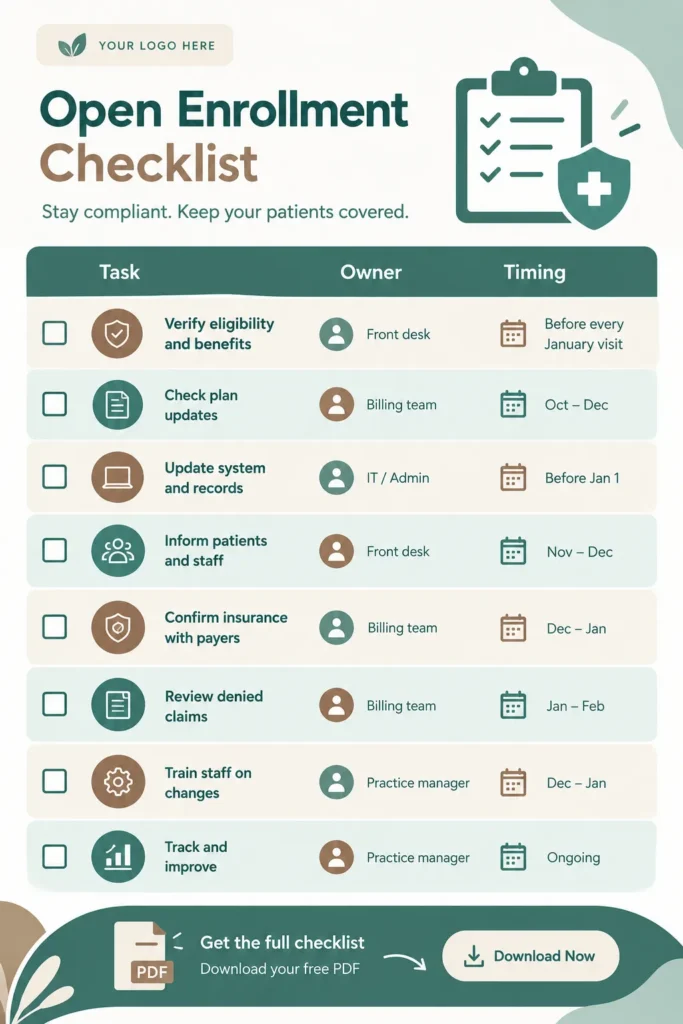
Use this open enrollment checklist to give every task an owner and a deadline:
| Task | Owner | When |
| Mark the Marketplace and Medicare dates on your team calendar | Practice manager | Now |
| Confirm which insurance products your providers except for 2027 | Billing or credentialing lead | Before the new plan year |
| Update your accepted insurance page and online listings | Marketing or web lead | After you confirm participation |
| Train the front desk on coverage questions and scripts | Practice manager | Before December 15 |
| Verify eligibility and benefits for the actual date of service | Front desk | Before every January visit |
| Check authorization and referral requirements | Authorization staff | Before scheduled services |
| Share cost estimates with patients | Billing team | Before the visit |
| Review early year claim denials from new plans | Billing lead | Weekly in January and February |
A Note from the Integrate Point Team
Plans change every year, even when patients keep the same one. Before the season starts, we suggest you review your accepted plans, your network status, your front desk scripts, and your estimate process. For the most accurate enrollment dates and eligibility rules, send patients to HealthCare.gov or Medicare.gov, depending on their coverage.
Open enrollment is a set window each year when people can sign up for a health plan, renew their coverage, or switch plans. Help your patients understand their eligibility and deadlines, direct them to official plan-comparison resources, and prepare your team to verify their coverage.
For the federal Marketplace schedule used in Texas, the ACA open enrollment period runs from November 1, 2026 to January 15, 2027. December 15, 2026 is the deadline for coverage that starts January 1, if the patient completes enrollment and pays the first premium.
No. Medicare Open Enrollment runs from October 15 through December 7 each year. Marketplace plans follow a separate schedule, and Medicare Advantage has its own additional window for eligible members. Medicare special enrollment periods have their own rules too.
Patient plan changes can create more eligibility checks, network questions, authorization work, cost estimates, and claim tasks. The effect depends on the patient’s new plan and the services you provide.
Patients can compare Marketplace plans on HealthCare.gov and Medicare plans on Medicare.gov. Send them to those official sites, and don’t recommend a specific plan unless your staff holds the license to give that advice.
No. Verification gives you information about coverage and benefits, but it doesn’t guarantee reimbursement. Plan terms, medical necessity, authorization, and claim adjudication rules still apply, so document each check.
Get Your Practice Ready for Open Enrollment
Preparing for year-end insurance changes? Make sure your team has the right processes for insurance verification, prior authorization, and revenue cycle management. Integrate Point supports healthcare practices with medical management services designed around their operational needs.
Ready to discuss your practice’s needs? Contact our team to explore the right support for your workflow.