
What is EOB in medical billing? EOB stands for Explanation of Benefits; the document a payer creates after it processes a claim. It shows the billed amount, the allowed amount, the insurance payment, adjustments, and patient responsibility. Your billing team uses it to post payments, apply adjustments, bill the right patient balance, and work denials.
An EOB is not a bill. Your practice sends the bill, and the payer sends the EOB, so don’t use an EOB to request payment. This guide shows you how to read an EOB, how it differs from an ERA, how to use it for payment posting, and how to interpret adjustment and denial codes.
Key Takeaways
- An EOB (Explanation of Benefits) shows how a payer processed a claim, but it isn’t a bill.
- An EOB explains benefits to the member, while an ERA gives your practice structured electronic payment data in the X12 835 format.
- Post payments by matching the claim, checking the allowed amount, applying contractual adjustments, and billing only the correct patient balance.
- An adjustment isn’t always a denial, so read the CARC, RARC, and group code together before you adjust, appeal, or bill.
- Check each payer’s rules and your contract, including whether a Texas plan is TDI regulated or self funded.
What Does EOB Stand for in Medical Billing?
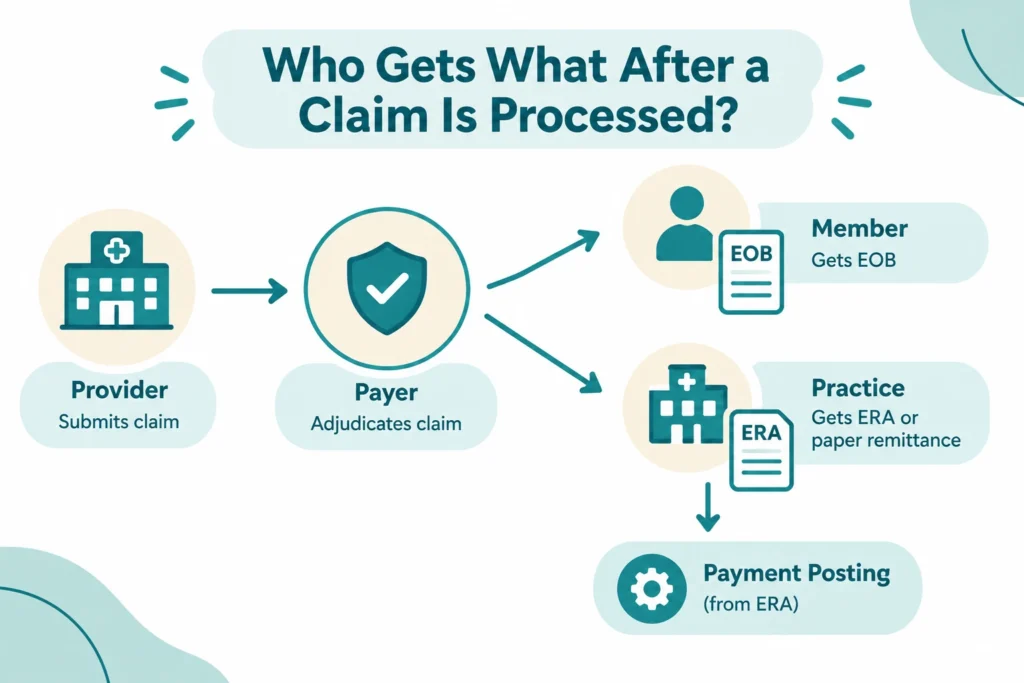
EOB stands for Explanation of Benefits. The EOB meaning in medical billing is the payer’s explanation of how it handled a claim. Payers issue an EOB after they adjudicate the claim, whether it was paid, adjusted, or denied, and it goes to the patient or member by mail or online. TDI explains that a health plan creates an EOB each time a provider submits a claim.
An EOB in healthcare matters to your billing team because it shows what the payer allowed, what it paid, and what it says the patient may owe. Your practice usually receives a separate remittance, often an ERA, for payment posting.
How Do You Read an EOB?
Start with the claim number and date of service, then read the allowed amount, adjustments, insurance payment, and patient responsibility. Here’s how to understand an EOB statement, field by field:
| EOB field | What it means |
| Patient or member | Identifies the covered person |
| Claim number | Identifies the processed claim |
| Date of service | Shows when care was provided |
| Provider charges | The amount you billed |
| Allowed amount | The amount the payer recognizes |
| Insurance payment | The amount the plan paid |
| Adjustments | Amounts removed or changed |
| Patient responsibility | The amount assigned to the patient |
| Claim status | How the payer processed the claim |
| Remark or adjustment codes | Extra processing details |
Layouts vary by payer, so check each payer’s format. Read the allowed amount and the adjustments first, because they explain the gap between your billed charge and the payment.

EOB Mismatch Checklist
When the EOB, ERA, posted payment, or patient balance disagree, work through these checks:
- Confirm the claim number, date of service, and patient match on every document.
- Compare the allowed amount with your payer contract.
- Read the adjustment codes to see why the payment differs from your billed charge.
- Match the posted payment to the ERA and the bank deposit.
- Compare patient responsibility with the plan’s deductible, copay, and coinsurance, and check for a secondary payer.
If the numbers still don’t match, contact the payer, then correct the claim or appeal as the payer instructs.
EOB vs. ERA: What’s the Difference?
An EOB is generally the member facing explanation of how a claim was processed. An ERA, short for electronic remittance advice, is the provider facing electronic remittance transaction your billing team uses in payment workflows.
| EOB | ERA |
| Explanation of Benefits | Electronic Remittance Advice |
| Primarily explains claim processing and benefits to the member | Provides structured electronic remittance information to the provider |
| Can be paper or electronic | Electronic transaction |
| Helps explain patient responsibility | Supports payment posting and reconciliation |
An ERA uses the HIPAA standard X12 835 transaction format, so your billing system can read it, match payments to claims, and post them. Your practice gets remittance data electronically because your system needs structured data. Patients get a separate EOB because members need a plain explanation of benefits.
Your billing team uses both. You post payments from the ERA, reconcile them against deposits, and turn to an EOB or paper remittance when you appeal a denial or answer a patient. Don’t treat the two as identical. An ERA isn’t just a digital EOB.
How Do You Use an EOB for Payment Posting?
EOB payment posting means matching the payer’s payment details to the right claim and recording each amount correctly. Follow these steps:
- Match the EOB or ERA to the correct claim.
- Verify the allowed amount against your contract.
- Post the payer’s payment.
- Apply contractual adjustments.
- Identify patient responsibility.
- Review remaining balances.
- Reconcile discrepancies.
- Route exceptions for follow up.
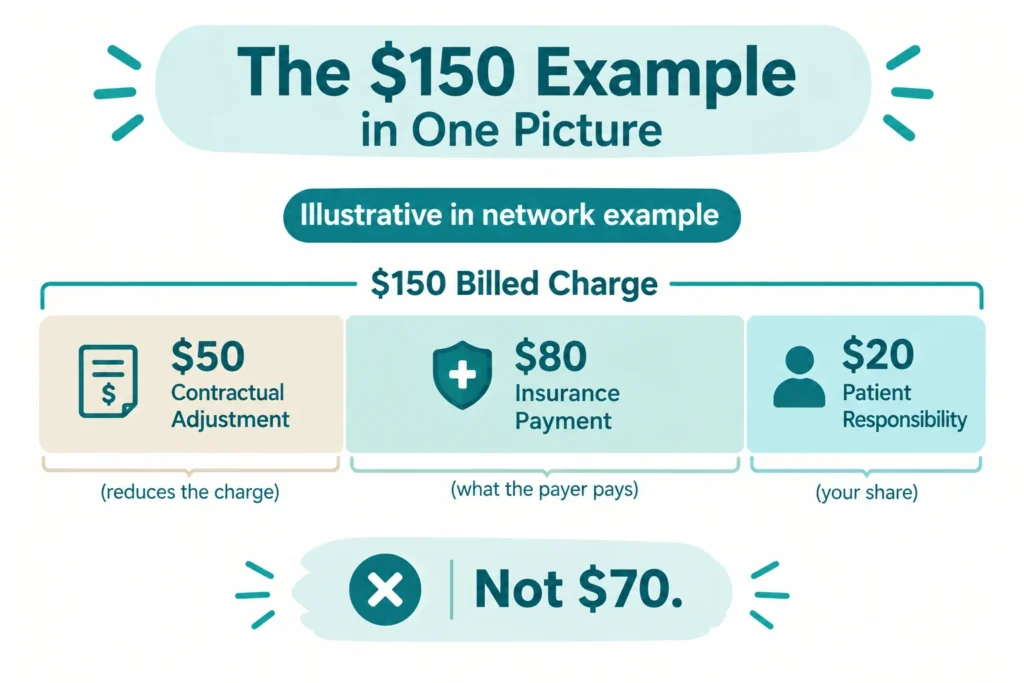
Example: how an EOB affects payment posting. This illustrative in network example shows how the amounts connect:
| Line | Amount | How it connects |
| Provider’s billed charge | $150 | What your practice charged |
| Contractual adjustment | $50 | Billed charge minus allowed amount, written off under your payer contract |
| Allowed amount | $100 | What the payer recognizes for the service |
| Insurance payment | $80 | Allowed amount minus the patient’s share |
| Patient responsibility | $20 | Deductible, copayment, or coinsurance applied to the allowed amount |
Patient responsibility is $20, not the $70 that the billed charge minus the insurance payment suggests, because your contract doesn’t let you bill the patient for the $50 adjustment. Actual amounts depend on the payer’s decision, the patient’s plan, and your contract terms.
Strong medical billing payment posting also needs payment reconciliation: confirm that your deposits match what you posted.
What Is Patient Responsibility on an EOB?
Patient responsibility in medical billing is the amount the payer says the patient may owe. It usually includes the deductible, copayment, coinsurance, and any non covered amounts the plan assigns to the patient. The EOB reports that amount, but it isn’t your bill. Before you send a statement, compare the EOB or ERA with your contract and your posted payment, so you bill only the correct balance.
How Do You Read EOB Adjustment and Denial Codes?
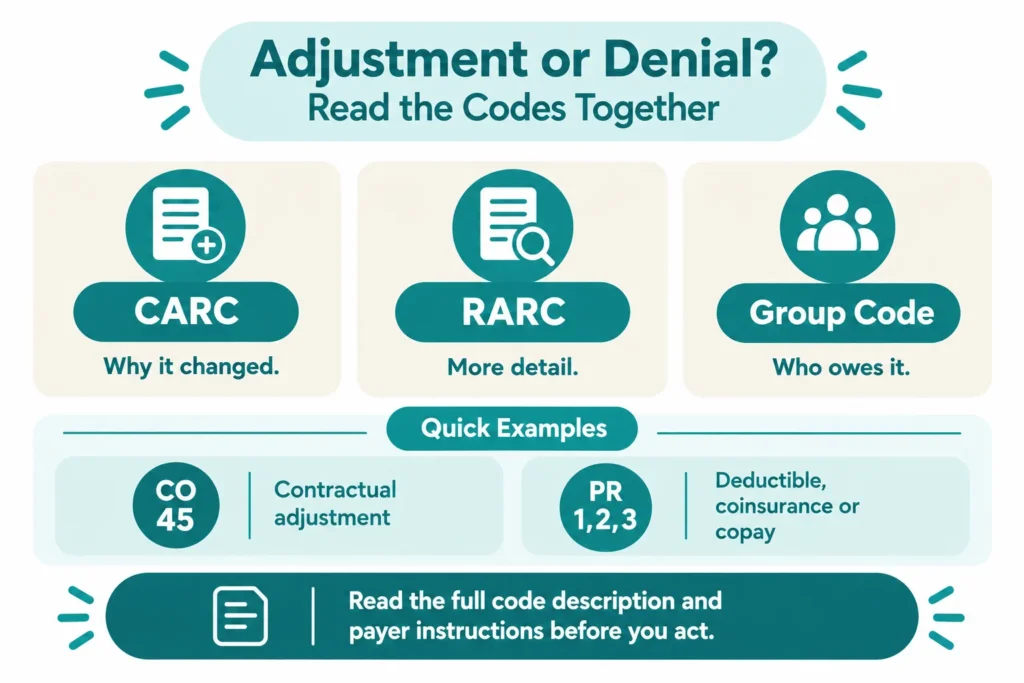
An adjustment isn’t the same as a denial. An adjustment changes the payment amount, while a denial means the payer didn’t pay a claim or a line. EOB adjustment and denial codes explain why a claim or line was paid differently than billed, so read them in context before you act:
- A Claim Adjustment Reason Code (CARC) says why an amount changed, and X12 maintains the CARC list.
- A Remittance Advice Remark Code (RARC) adds detail about a claim or line, and X12 hosts the RARC list.
- A group code shows who owes the amount: CO means contractual obligation, and PR means patient responsibility.
For example, CARC 45 with a CO group code usually reflects a contractual adjustment, not a denial. PR with CARC 1, 2, or 3 reports the patient’s deductible, coinsurance, or copayment.
Before you adjust a balance off, appeal, or transfer it to the patient, read the full code description and the payer’s instructions. Codes can vary by payer and claim context.
Denial Management and Common EOB Mistakes
When an EOB or ERA shows a denial, work it in order: review the reason, decide who is responsible, correct or appeal, resubmit, track, and follow up in A/R. That’s medical billing denial management in practice. Common denial categories include eligibility, authorization, coding, medical necessity, timely filing, duplicate claims, non covered services, and coordination of benefits.
Many denials start at the front desk, so verify insurance before every visit and follow a clear appeal process when a claim is denied. Watch for these common EOB mistakes:
- Posting payment to the wrong claim
- Missing contractual adjustments
- Misreading patient responsibility
- Ignoring remark codes
- Treating a denial as a write off
- Missing appeal or timely filing deadlines
- Failing to reconcile the EOB and ERA
- Sending an incorrect patient balance
Texas callout (educational, not legal advice): These timelines apply to qualifying claims and plans, mainly those regulated by the Texas Department of Insurance, not to every plan. TDI guidance says carriers generally must pay, deny, or request more information within 30 days of a clean electronic claim, or 45 days of a paper claim, and providers generally must file within 95 days of the date of service. Self funded plans, Medicare, and Medicaid follow other rules, so check TDI and your payer contracts.
Before You Post That EOB, Check This First
EOB and ERA formats vary by payer, and adjustment and denial handling depends on the claim’s circumstances. Verify each payer’s requirements in your contract and provider manual, including whether a Texas plan is TDI regulated or self funded. This article is educational, and it doesn’t replace payer guidance or legal advice.
Not always. A $0 amount can reflect a met deductible or a contractual adjustment, but it can also mean a denial or another payer’s share. Check the adjustment codes and any secondary insurance before you close the balance.
In network, usually not. Your payer contract controls the amount, and a CO group code signals a contractual obligation your practice absorbs. Review your contract before you bill an adjusted amount.
Usually not. Payers send the EOB to the member and a remittance to your practice, often an ERA. A patient may share an EOB, but don’t rely on it for payment posting.
Original Medicare sends beneficiaries a Medicare Summary Notice, and providers receive a Medicare remittance advice. Medicare Advantage plans typically send an EOB. Check each payer’s format.
A denial means the payer paid nothing on a claim or a line. An underpayment means the payer paid less than your contracted allowed amount. Compare the allowed amount on the remittance with your contract, then follow the payer’s appeal or reconsideration process if it’s lower.
Yes. If you don’t receive an ERA, post from the payer’s paper remittance and check every amount against the claim. Manual posting takes more time and carries more keying risk, so ask each payer how to enroll for electronic remittance.
Every EOB Tells Your Billing Team What to Do Next
What is EOB in medical billing, in practice? It’s the payer’s explanation of how it processed a claim, and it tells your team what to do next: post a payment, adjust a balance, bill the patient, or work a denial.
Read EOBs and ERAs accurately, and you post cleaner payments and manage denials with more confidence. Integrate Point’s revenue cycle management services can support your practice with payment posting, denial follow up, and accounts receivable.