
Your practice posts a short video, the views climb, and the phone stays quiet. That gap costs you patients you never knew you had. Social media marketing for doctors only pays when each video moves a viewer toward your website, your phone line, or an appointment request.
This guide shows practice owners and administrators how to build that path: which platforms to use, which content to create, how to track cost per lead and inquiry to appointment conversion, how to stay compliant, and when to hire help. Treat it as one part of your medical practice marketing plan.
Key Takeaways
- Give every short video one job and one next step.
- Pick two platforms you can maintain, not five you neglect.
- Track cost per lead, inquiry to appointment conversion, and patient lifetime value, not just views.
- Get written HIPAA authorization before any patient appears, and check FTC and state board rules.
- Compare staff capacity and agency cost before you decide who runs your channels.
The Biggest Mistake Medical Practices Make with Short Form Video Marketing
Most practices measure the video and overlook what happens after the view. Short videos alone don’t create a reliable patient acquisition strategy. Your practice also needs relevant website pages, clear calls to action, and a process for answering inquiries.
What Is Social Media Marketing for Doctors?
Social media marketing for doctors means using social platforms to share educational content, introduce your providers, explain your services, and send potential patients to your website. Your practice publishes useful information, and viewers decide whether to contact you. Short videos make that exchange fast, because they show your team and answer questions in seconds.
Healthcare content marketing ties those posts to website pages, so each video supports a page that explains the topic in more detail.
Why Does Social Media Matter for Medical Practices?
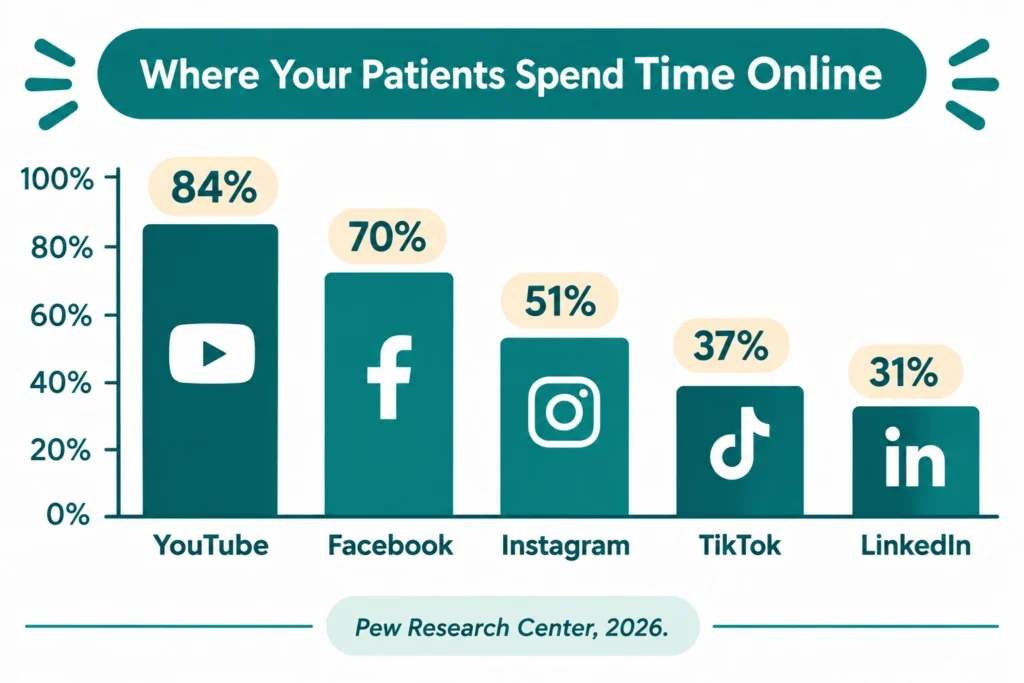
Social media matters because your potential patients already spend time on these platforms, and you can reach them with useful information before they search for a provider. Pew Research Center’s 2026 survey found that 84% of U.S. adults use YouTube, 70% use Facebook, and 51% use Instagram.
Social media marketing for medical practices builds patient engagement, service awareness, and inquiries, but it does not guarantee new patients, so measure what it produces. Healthcare video marketing also lets you show your providers and explain services before a patient ever calls. Reach is only the first step. Your website, your front desk, and your follow up decide whether a viewer becomes a patient.
Which Social Media Platforms Should Your Practice Use?
Use the platforms your potential patients already visit and your team can maintain, and start with two. YouTube Shorts and Instagram suit short form video marketing, Facebook suits local communities, TikTok suits casual education, and LinkedIn suits referral and employer audiences.
| Platform | U.S. adults who use it (Pew, 2026) | Best use for your practice |
| YouTube Shorts | 84% | Educational explanations that link to deeper pages |
| 70% | Local updates, events, and community posts | |
| 51% | Reels and Stories for introductions and FAQs | |
| TikTok | 37% | Approachable education with clear professional boundaries |
| 31% | Referral partners, hiring, and employer outreach |
Social media platforms for healthcare work best when you match each one to your audience, your goals, and your resources, including who films, who edits, and who answers comments.
What Short Videos Should Your Practice Create?
Create videos that answer a patient’s question, introduce a person, or explain a service. Video marketing for doctors works when every clip has one purpose, runs under a minute, and ends with one next step, not when it reads like an advertisement.
- Provider introductions: A doctor explains who they treat and how they work.
- Service explanations: A short overview of one treatment or service.
- Common questions: An answer to something your front desk hears daily.
- Process explainers: How referrals or prior authorizations work.
- Practice updates: A new service or office change.
Start with the questions your front desk answers most.
What Content Works Beyond Video?
Healthcare content marketing also includes formats beyond video. Mix short videos with formats that build trust and patient engagement. Behind the scenes posts, live Q&A sessions, seasonal tips, and local partnerships give potential patients more ways to know your practice, and patient testimonials work only with consent.
- Testimonials with consent: Get written authorization before you share any patient’s story.
- Behind the scenes: Show your team and your office, with no patients in frame.
- Live Q&A: Answer general questions in real time, and never discuss individual care.
- Seasonal tips: Share general advice, such as allergy or flu season reminders.
- Local partnerships: Feature referral partners and community events.
Free download: 30-Day Short-Video Calendar for Medical Practices
Publish 12 short videos in 30 days. Each video has one topic, one call to action, and one landing page. Includes a pre-publish privacy checklist and a tracking sheet for cost per lead.
How Do You Turn Views into Patient Leads?
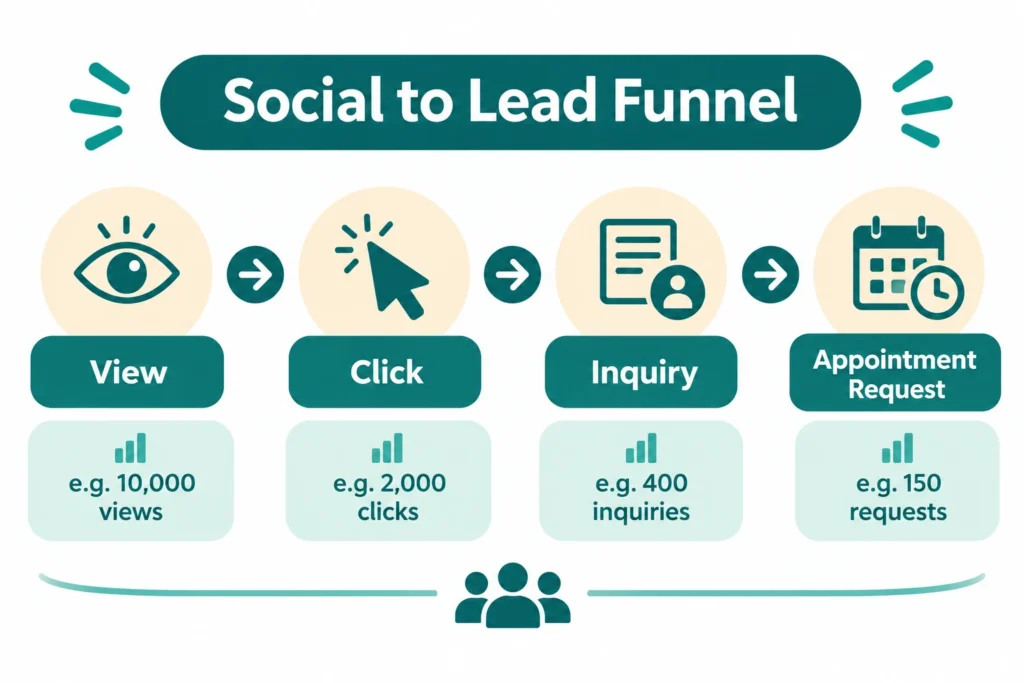
Healthcare social media marketing turns views into leads when you build a clear path from each video to a contact: view, click, inquiry, appointment request. Remove friction at every step, then measure where viewers drop off. Views alone don’t fill your schedule. Inquiries and booked appointments do.
Add one clear call to action. Tell viewers what to do next, and show it on screen. For example, say, “Visit our website to request an appointment.”
Send viewers to the right page. Link each service video to its matching service page, not your homepage. Strong healthcare website design and healthcare SEO keep that page working long after the post fades.
Make requests easy. Show your phone number, form, and scheduling option on mobile friendly pages, and answer fast. Appointment scheduling support helps your front desk keep up.
Track the whole journey. Follow views, link clicks, inquiries, and appointment requests, so you can see which stage loses the most people. Ask new patients how they found you, and record the answer at scheduling.
Four stage funnel showing view, click, inquiry, and appointment request, with the metric to track at each stage
Client result (anonymized): A [specialty] practice generated [X] views, [Y] website clicks, [Z] inquiries, and [N] booked appointments in [time]. [Replace with approved client data.]
How Does Paid Social Fit In?
Paid social amplifies content that already works. Boost proven videos to local audiences, send clicks to a matching landing page, and judge results by cost per lead and booked appointments, not clicks. Set a monthly budget cap, and read each platform’s healthcare ad policies before you launch.
Don’t use patient lists or health information for targeting without your compliance advisor’s approval.
How Do You Measure Results?
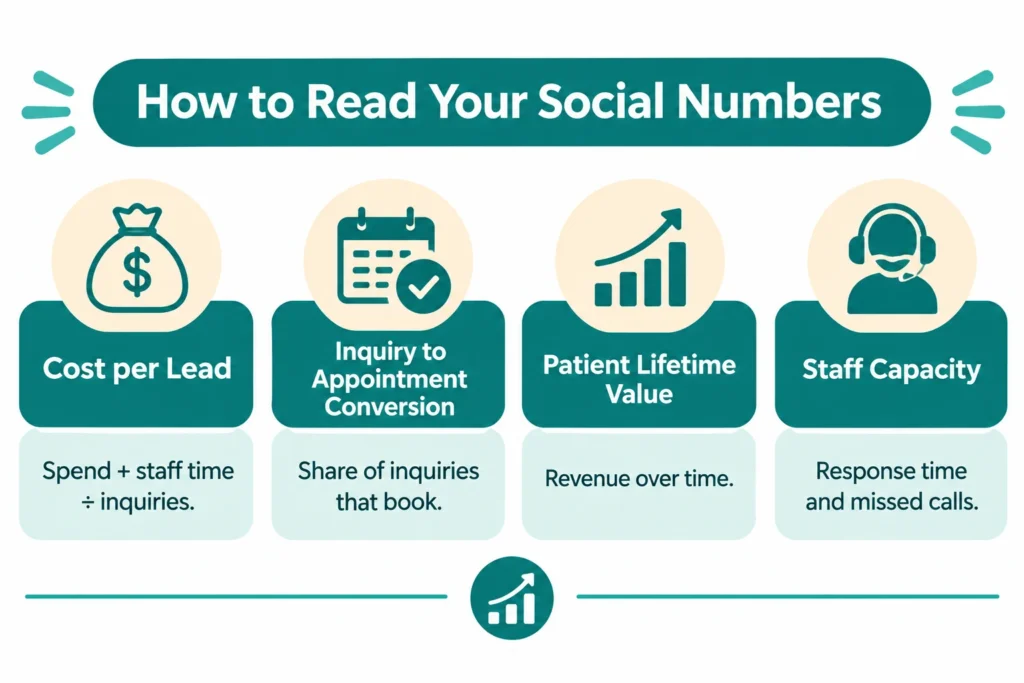
Healthcare social media marketing earns its budget only when it produces inquiries, so measure business outcomes, not attention. Track cost per lead, inquiry to appointment conversion, patient lifetime value, and your staff capacity to respond, then compare them month to month. Views show interest, but these numbers show whether social media earns its place in your budget.
| Metric | What it tells you | Why it matters |
| Cost per lead | Spend plus staff time, divided by inquiries | Shows efficiency |
| Inquiry to appointment conversion | The share of inquiries that book | Shows front desk and offer strength |
| Patient lifetime value | Estimated revenue a new patient brings over time | Sets what a lead is worth |
| Staff capacity | Response time and missed calls | Shows whether you can handle more inquiries |
| Website clicks | Viewers who reached your site | Shows how well content matches pages |
How Do You Keep Social Media Compliant?
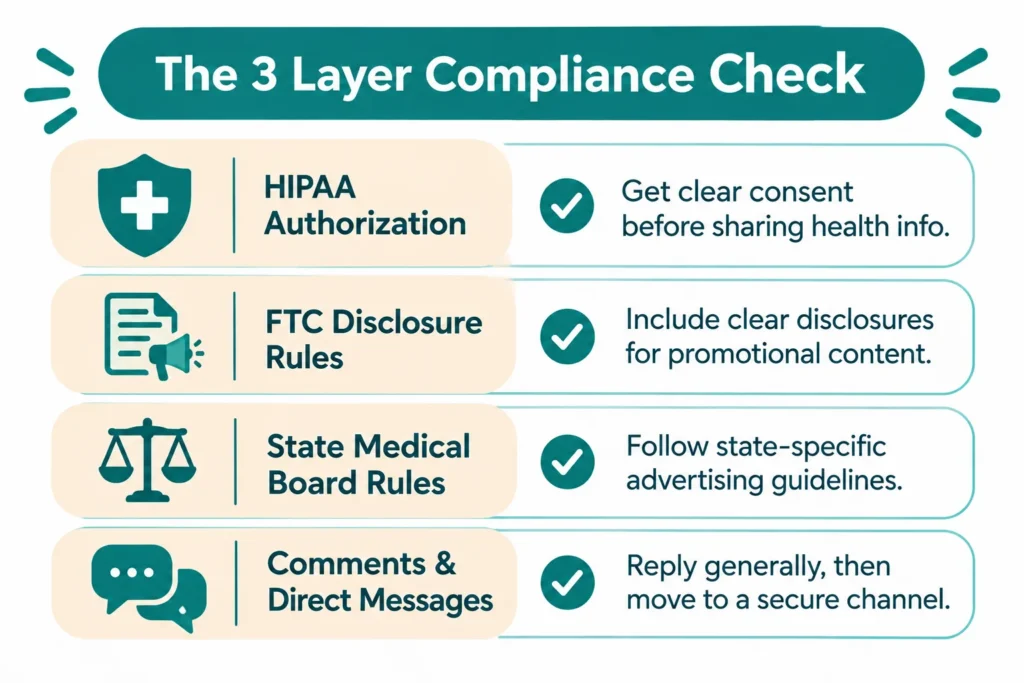
Keep social media compliant by treating every post as marketing that needs authorization, honest claims, and privacy review. Check three layers before you publish each post: HIPAA, the FTC’s endorsement and review rules, and your state medical board’s advertising rules.
HIPAA. HHS explains that HIPAA generally requires written authorization before you use or disclose protected health information for marketing, with limited exceptions. Don’t show patient names, faces, voices, or records without it, and review backgrounds, screens, and audio before posting. See our HIPAA marketing guidance.
FTC rules. The FTC’s Endorsement Guides require clear disclosure of any material connection, such as payment or free services, with someone who endorses you. Its rule on reviews and testimonials also bans fake reviews and undisclosed insider reviews.
State medical boards. Boards set their own advertising rules, and some restrict testimonials. Confirm yours before you post.
Comments and direct messages. Reply with general information only and move patient specific conversations to a secure phone line, portal, or HIPAA compliant messaging tool. Ask your compliance advisor to approve your reply to templates and keep a record of every approval.
Should You Run Social Media in House or Hire an Agency?
Run it in house when a trained team member has the time, the video skills, and compliance knowledge. Hire an agency when your staff capacity is limited, you manage several locations, or you need reporting that ties your medical practice marketing to booked appointments.
| Factor | In house fits when | An agency fits when |
| Staff capacity | A trained team member has time | Your front desk and providers are stretched |
| Compliance risk | Someone reviews every video | You need healthcare privacy experience |
| Reporting | You can track inquiries to appointments | You need cost per lead and conversion reporting |
Integrate Point provides healthcare social media management for practices that want that support.
Your Best Video Topic Is Sitting at Your Front Desk
Ask your front desk which question callers repeat most. That answer is your best video topic, and the callers’ own wording is your best script. Most practices guess at content ideas while the answers sit at the front desk
There’s no single right number. Choose a frequency your team can sustain with privacy review, such as a few posts each week, and raise it only when you can keep quality and response times steady.
Not every practice must, but most benefit from a presence where potential patients already look. Pew finds that most U.S. adults use YouTube and Facebook. If your team can’t manage several platforms, start with one.
Sometimes, but not casual. You need written HIPAA authorization, clear FTC disclosures for any incentive, and a check against your state’s medical board’s advertising rules, which can restrict testimonials. Ask your compliance advisor first.
Start where your potential patients already are and your team can post consistently. Many practices begin with YouTube Shorts or Instagram Reels, then add Facebook for local reach after they can maintain the first channel.
Get written authorization before any patient appears, review every video for backgrounds and screens, and keep patient specific conversations off public comments and direct messages. Write staff rules and ask your compliance advisor to approve them.
Often, yes. Pew finds that 70% of U.S. adults use Facebook, and it suits local audiences and community posts. Use it for practice updates, general health tips, and local partnerships, and judge it by inquiries, not likes.
Stop Chasing Views: Start Turning Videos Into Patient Leads
Social media marketing for doctors should do more than raise views and followers. Your practice needs a clear plan that helps potential patients discover your services, understand what you offer, and contact your office. Choose suitable platforms, create useful videos, protect patient privacy, and track cost per lead and booked appointments, and your marketing team can make social media a measurable part of practice growth.
Find where your videos lose viewers. We review your healthcare video marketing, website, and inquiry process, and show you what to fix first.