
Prior authorization reform is changing how Texas healthcare providers handle payer approvals, clinical documentation, and claim reviews. Three major initiatives are driving these changes: the federal CMS-0057-F rule, the Texas Gold Card Law, and Medicare’s WISeR model. Understanding how each applies to your practice can help prevent authorization delays, avoidable denials, and payment disruptions.
Key Takeaways
- CMS-0057-F sets prior authorization decision deadlines and denial notice requirements for specified payers, with API requirements generally beginning in 2027.
- Texas Gold Card rules provide prior authorization exemptions for qualifying providers and services.
- Texas SB 815 restricts automated systems from making adverse utilization review determinations.
- Medicare WISeR adds prior authorization or prepayment review for selected Original Medicare services.
- Track payer requirements, authorization decisions, exemptions, and denial reasons to prepare your practice.
What Does the CMS-0057-F Final Rule Require?
The CMS-0057-F rule requires most impacted health plans to process prior authorization requests faster, explain denials, and share patient information through FHIR APIs. It mainly regulates payers, but eligible hospitals and clinicians also have an electronic prior authorization reporting requirement beginning in 2027.
Which payers must follow the rule?
CMS identifies these as impacted payers:
- Medicare Advantage organizations
- State Medicaid and CHIP fee-for-service programs
- Medicaid managed care plans
- CHIP managed care entities
- Qualified Health Plan (QHP) issuers on federally facilitated exchanges
Traditional Medicare, Medicare Part D, and drug prior authorization are excluded.
Read the CMS-0057-F final rule and fact sheet for the full requirements.
What are the key requirements?
- Faster decisions: Since January 1, 2026, most impacted payers must decide expedited requests within 72 hours and standard requests within seven calendar days. These deadlines do not apply to QHP issuers on federally facilitated exchanges.
- Permitted extensions: Certain programs, including Medicare Advantage and some Medicaid and CHIP programs, allow extensions of up to 14 additional calendar days when specific conditions are met.
- Clear denial reasons: Payers must provide a specific reason for each applicable prior authorization denial.
- Public reporting: Payers must publish prior authorization metrics annually. The first reports were due March 31, 2026.
- Provider reporting: Beginning in 2027, eligible clinicians and hospitals must meet an electronic prior authorization reporting measure.
See the CMS prior authorization timeframe guidance for payer-specific deadlines and extensions.
What does this mean for your practice? If a Medicare Advantage plan denies an MRI request, review the denial reason, correct missing documentation, and resubmit or appeal as appropriate. Track payer decisions to identify recurring authorization problems.
How Does the Texas Gold Card Law Work in 2026?
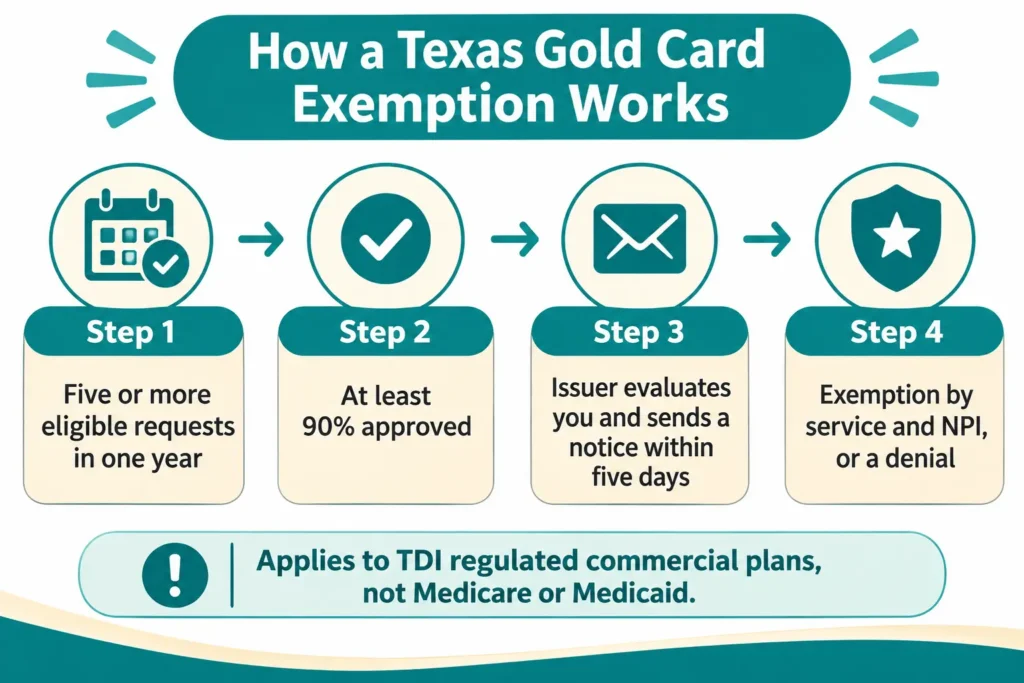
The Texas Gold Card Law allows qualifying providers to receive prior authorization exemptions for specific services when they meet an insurer’s approval requirements.
The exemption applies to the qualifying service and issuing insurer, not automatically to every payer.
Here is what providers need to know:
- Eligibility: At least five eligible preauthorization requests for a particular service during a 12-month evaluation period, with an approval rate of 90% or higher.
- Automatic evaluation: Insurers review provider records. Providers do not need to submit a separate application.
- Exemption scope: The exemption applies to the qualifying provider, service, and insurer. It does not automatically extend to Medicaid, CHIP, Medicare Advantage, or self-funded employer plans.
- Denials and appeals: Providers can request independent review if an exemption is denied or rescinded. Insurers can rescind exemptions only under specified conditions.
- 2027 reporting: Applicable insurers must submit annual exemption data to TDI by March 1, beginning in 2027.
Read the TDI Gold Card FAQ for eligibility, evaluations, appeals, and rescission requirements.
What Should Healthcare Practices Do?
Track authorization approvals by payer, NPI, and service. Monitor approval rates, maintain supporting documentation, and confirm exemption status with each insurer before changing your authorization workflow.
Key update: TDI’s updated implementing rules take effect November 29, 2026. See TDI’s 2026 adopted rules.
What Is the Medicare WISeR Model, and How Does It Affect Texas Providers?
The Medicare WISeR model requires prior authorization or prepayment review for selected Original Medicare services in Texas from 2026 through 2031. It does not apply to Medicare Advantage. Providers should check the CMS covered-service list before scheduling affected procedures.
Here is what your practice needs to know:
- Covered services: CMS lists the procedures subject to review in its Provider and Supplier Operational Guide. Check the list before scheduling services such as implanted nerve stimulators.
- Request submission: Cohere Health reviews WISeR requests in Texas. Providers can submit directly to Cohere or through Novitas, which forwards requests to Cohere.
- Exemption criteria: The exemption program began in July 2026. According to criteria Cohere shared with the Texas Medical Association, providers may qualify with at least 10 WISeR submissions, a 90% approval rate, and no listing on the CMS or OIG exclusion lists. Providers cannot apply directly, so confirm their status with Cohere.
- Review process: If you do not submit a prior authorization request for an included service, the claim may undergo prepayment review.
Check the CMS WISeR Model page and the WISeR Provider and Supplier Operational Guide for covered services and submission instructions. The Texas Medical Association WISeR update provides additional provider guidance.
What should your practice do? Check whether your services are included, confirm the submission route, and track authorization decisions and exemption status.
Our RCM team can review your authorization workflows and denial patterns.
CMS-0057-F vs. Texas Gold Card vs. WISeR: What Is the Difference?
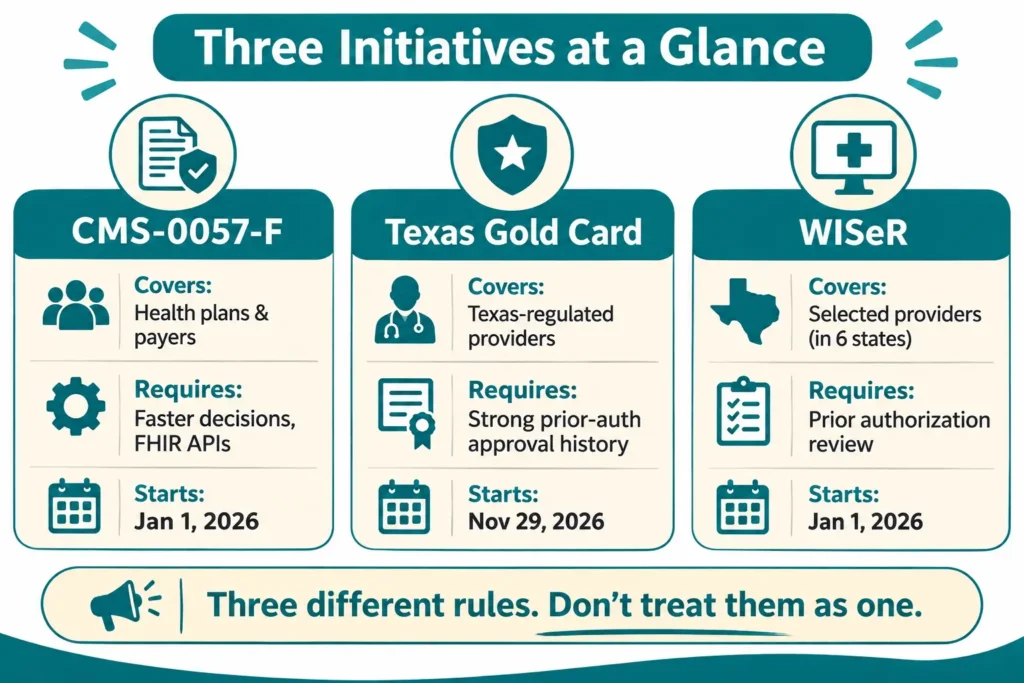
These three initiatives address different parts of prior authorization. Understanding their scope helps your team apply the right requirements.
| Initiative | Who it applies to | Main requirement | Key dates | What providers should do |
| CMS-0057-F | Specified payers | Decision deadlines, denial reasons, public metrics, and FHIR APIs | Operational rules from 2026; APIs generally from 2027 | Track payer deadlines and denials |
| Texas Gold Card | Eligible providers and TDI-regulated insurers | Exemptions for qualifying services | HB 3812: September 1, 2025; updated TDI rules: November 29, 2026 | Track approval rates and exemption status |
| WISeR | Providers delivering selected services to Original Medicare patients in participating states | Prior authorization or prepayment review | January 1, 2026–December 31, 2031; exemptions began July 2026 | Check covered services and exemption status |
What Are the Key Deadlines and Healthcare Regulatory Changes to Watch?
Healthcare providers need to track the 2026 prior authorization requirements and the 2027 electronic data exchange changes. Texas providers must also prepare for the updated Gold Card rules and WISeR reviews.
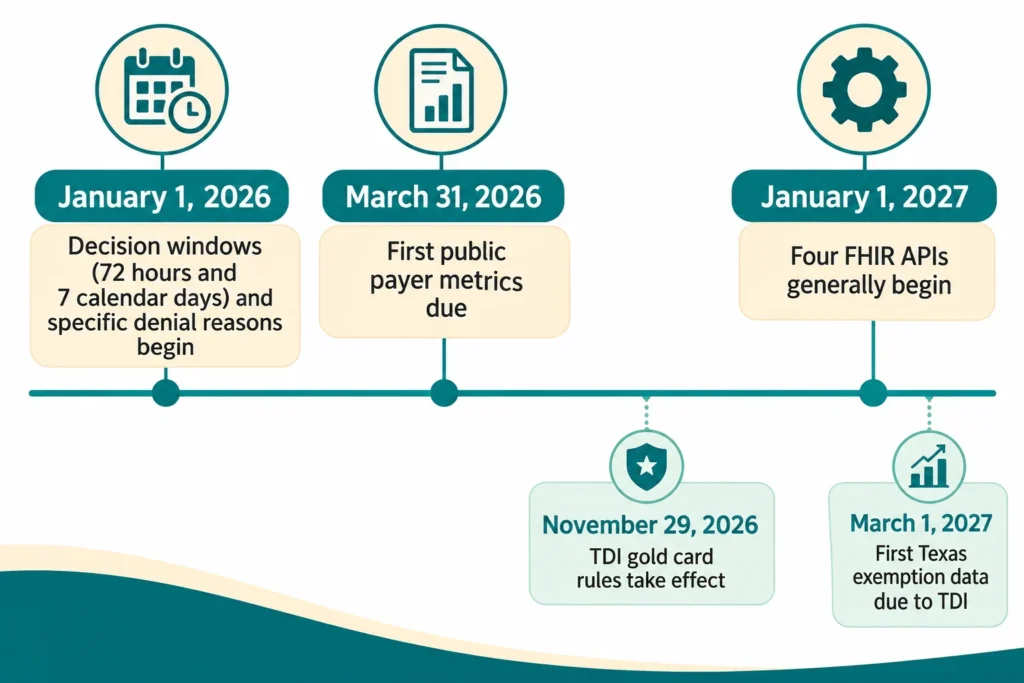
Key dates for your practice
- January 1, 2026: Most impacted payers began following CMS prior authorization decision deadlines and denial-reason requirements.
- March 31, 2026: First public prior authorization metrics were due from impacted payers.
- July 2026: The Medicare WISeR exemption program began.
- November 29, 2026: TDI’s updated Gold Card implementing rules take effect.
- January 1, 2027: Most CMS-0057-F API requirements begin, subject to payer-specific timelines and exceptions.
- March 1, 2027: Applicable Texas issuers must submit their first annual Gold Card exemption data to TDI.
What do these changes mean for providers? Payers face greater expectations for faster decisions, clearer denial explanations, and electronic data exchange. Track authorization requests, payer response times, denial reasons, and exemption status now instead of waiting until 2027.
Which Medical Claim Denial Reasons and Medical Denial Codes Matter Most?
Many authorization-related denials happen because approval was missing, the authorization number was incorrect, or the service exceeded the approved limits. Tracking the denial code helps your billing team identify where the process failed.
The AMA’s 2024 survey found that physicians complete an average of 39 prior authorization requests per week and spend 13 hours weekly on the workload. In addition, 75% reported that denials had increased over five years, while 31% said requests were often or always denied.
Read the AMA prior authorization survey findings.
Which denial codes should your team monitor?
- CARC 197: Authorization or notification was absent.
- CARC 15: The authorization number was missing, invalid, or inapplicable.
- CARC 198: The service exceeded the authorized amount or scope.
Check the official X12 Claim Adjustment Reason Code list for current code descriptions.
Each code points to a different problem. Link every denial to its authorization record and group denial reasons by payer. This helps your team identify recurring errors in scheduling, registration, documentation, and billing.
How Do Insurance Claim Appeals Work After a Prior Authorization Denial?
Review the denial notice, request a peer-to-peer discussion when applicable, and file an appeal if the denial remains. Texas law gives providers an opportunity to discuss certain adverse determinations with a Texas-licensed physician in the same or similar specialty before the plan issues its decision.
Texas SB 815 also changes how utilization review agents can use automated systems.
For health benefit plans delivered, issued, or renewed on or after January 1, 2026:
- Utilization review agents cannot use automated decision systems to make adverse determinations, either wholly or partly.
- Algorithms and AI systems may still support administrative tasks and fraud detection.
- Denial notices must include the principal reasons, clinical basis, and the source of the screening criteria and review procedures.
Keep the denial notice, clinical records, authorization history, and appeal documents together.
Read the enrolled Texas SB 815 bill and TDI’s peer-to-peer review guidance.
How Can Your Practice Prepare for FHIR API Requirements?
CMS requires impacted payers—not providers—to build four FHIR APIs. Your practice should prepare its workflows to access and use the information these APIs provide.
What do the four APIs do?
- Patient Access API: Gives patients access to health information, including prior authorization data.
- Provider Access API: Shares patient data with in-network treating providers.
- Payer-to-Payer API: Transfers patient data when patients change health plans.
- Prior Authorization API: Shares covered-service requirements, documentation rules, and authorization request and response information.
Most requirements begin January 1, 2027, with payer-specific exceptions. CMS also allows enforcement discretion for covered entities using an all-FHIR Prior Authorization API instead of the HIPAA X12 278 transaction.
Texas has separate electronic prior authorization requirements. Insurance Code Chapter 1217 addresses prior authorization for health care services, while Chapter 1369 includes requirements for prescription drug benefits. These are distinct from the federal FHIR API requirements.
How should your practice prepare?
Use a consistent workflow for every authorization:
- Verify coverage: Confirm the payer, plan type, and applicable program, including Medicare Advantage, Medicaid, TDI-regulated plans, or Original Medicare under WISeR.
- Check requirements: Confirm the CPT or HCPCS code, supporting documents, and any applicable exemption.
- Submit and record: Document the submission date, method, urgency, and supporting records.
- Track the outcome: Monitor payer deadlines, decisions, and denial reasons.
- Resolve denials: Correct documentation, request peer-to-peer review, or appeal when appropriate.
Remember, FHIR improves data exchange, but it does not guarantee authorization approval. Your team still needs to verify payer requirements and track every request.
What Should You Do When a Payer Misses a Deadline?
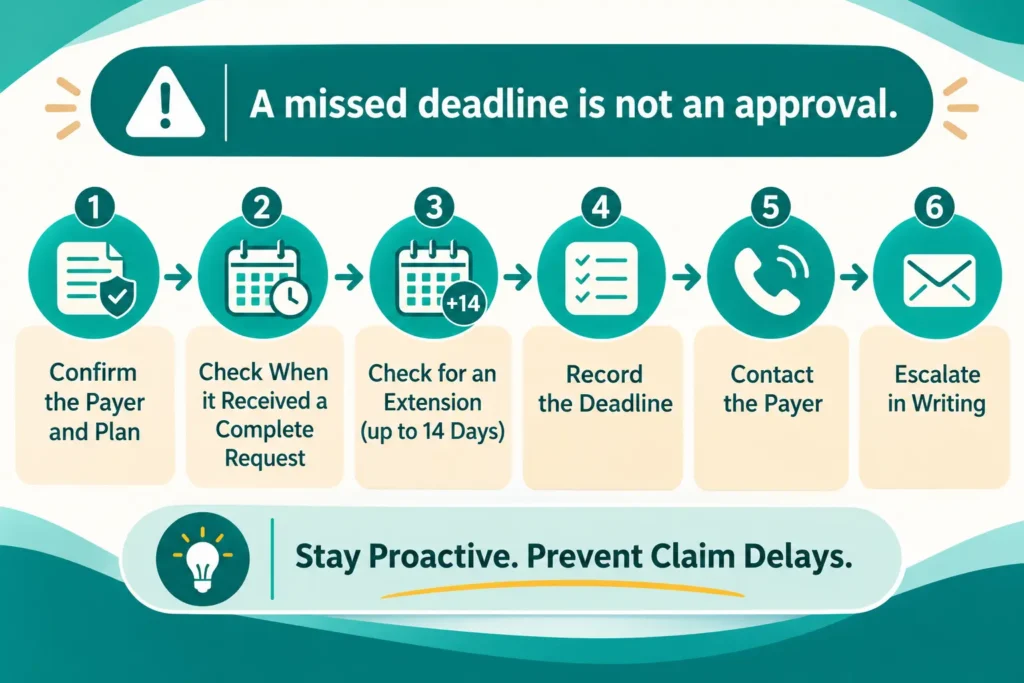
Document the delay, contact the payer, and escalate in writing—but never assume that silence means approval.
Before escalating, confirm:
- The payer and plan are covered by the applicable deadline.
- The date and time the payer received the request.
- Whether the request was expedited or standard.
- Whether a permitted extension applies.
For example, if a standard Medicare Advantage request has no decision after seven calendar days, check whether an extension applies. Record the submission details, contact the payer, and escalate through provider relations or the appropriate grievance process if needed.
What Are Typical Hospital Claim Timelines, and How Can You Track Them?
Hospital claim payment timelines depend on the payer, claim type, and documentation. For Original Medicare, clean electronic claims have a 14-day payment floor. Processing can take longer if the Medicare Administrative Contractor needs more information. Interest generally applies when a clean claim is not paid within 30 calendar days.
Texas commercial plan deadlines vary by plan and provider arrangement. Check the applicable TDI prompt-pay guidelines.
Hospital claims may also take time to submit because billing teams must complete discharge, coding, and documentation reviews.
Track these four claim stages
- Authorization: Confirm approval when required.
- Submission: Send the coded claim after discharge.
- Adjudication: Monitor payer decisions and requests for information.
- Payment posting: Review the ERA or 835 remittance advice and post payments or adjustments.
Use these steps to track progress
- Check clearinghouse acknowledgments after submission.
- Use 276/277 inquiries to monitor claim status.
- Review 835 remittance advice when available.
- Sort unpaid claims by age: 0–30, 31–60, 61–90, and over 90 days.
- Flag delayed claims and follow up with the payer.
Keep submission dates, payer responses, follow-ups, and payment records together. This helps your team identify delays and manage unpaid claims.
For Medicare claim status and payment-floor details, refer to the CMS Medicare claim status guide.
Get the 2026 Texas Prior Authorization Readiness Checklist
Use this checklist to prepare your practice for Texas prior authorization changes and reduce avoidable delays and denials.
Your checklist should help your team:
- Map CPT and HCPCS codes to payer requirements for Medicare Advantage, Medicaid STAR, commercial plans, and WISeR.
- Track payer response times against applicable 72-hour and seven-day decision windows.
- Record denial reasons and relevant medical denial codes.
- Monitor Texas Gold Card eligibility and exemption status.
- Check payer readiness for the 2027 FHIR API requirements.
- Document authorization submissions, follow-ups, decisions, and appeals.
The Workflow Gap Your Practice Can’t Afford to Ignore
Our team helps healthcare organizations strengthen prior authorization and revenue cycle workflows through payer-rule reviews, authorization tracking, denial analysis, and process improvement. We focus on practical steps that help providers reduce avoidable delays, improve documentation, and keep claims moving forward.
It applies to specified payers, including Medicare Advantage, Medicaid and CHIP programs, and QHP issuers on federally facilitated exchanges for applicable provisions. It does not directly cover most employer-sponsored plans.
You need at least five eligible preauthorization requests for a particular service during the evaluation period, with an approval rate of 90% or higher. The insurer evaluates your records, so you do not apply separately.
No. WISeR applies to selected services for people with Original Medicare in participating states. Medicare Advantage plans follow their own prior authorization requirements.
No. CMS requires impacted payers to build the API, not providers to use it. Your practice can continue using existing submission channels while reviewing each payer’s implementation plans.
Most CMS-0057-F API requirements begin January 1, 2027. Specific payer types may have different dates or exceptions. Ask each payer about its implementation timeline.
Turn Prior Authorization Reform into a Revenue Advantage
Prior authorization reform will keep changing, so start with three moves this week. Assign one person to track regulatory updates, build a payer specific authorization matrix, and review every denial by code. Then check your gold card and Medicare WISeR exemption status. Integrate Point’s revenue cycle management services can help you build and monitor that process